

For many people, FMEA is associated with a table, ratings, and a long meeting after which everyone goes back to their daily tasks. In theory, the functions are listed, potential failures are identified, and actions are assigned. The problem starts a few months later, when a customer complaint appears and the team realizes that the risk analysis existed on paper, but did not really help in practice.
This is exactly where the role of the FMEA moderator comes in.
It is a role that is often misunderstood. Sometimes the moderator is treated as the person responsible for filling in the form. Sometimes as someone who is expected to come up with the whole analysis on their own. And sometimes as the meeting secretary who simply writes down what other people say.
In practice, none of these versions describes the role properly.
A good FMEA moderator does not replace the team. They do not make all technical decisions on behalf of everyone else. They do not guess what the process owner had in mind. Their job is different: to guide the team through the risk analysis in such a way that the discussion leads to clear conclusions, practical actions, and a better understanding of the process.
Who is an FMEA moderator?
An FMEA moderator is a person who guides the team through the risk analysis in a structured way.
That sounds simple, but this is where the first difficulties appear. Leading the analysis does not mean that the moderator knows the entire process better than everyone else, understands every technical detail, and can predict every possible failure.
That is what the team is for.
In FMEA, especially when we talk about Process FMEA, you need people from different areas: quality, production, process engineering, maintenance, project management, and sometimes logistics as well. The moderator’s job is to make sure this knowledge is used properly.
In practice, the moderator takes care of several things.
First, they keep the logic of the analysis under control. The team should move through functions, potential failure modes, effects, causes, and current prevention and detection controls in a way that makes sense. Without jumping from one topic to another. Without entries like “operator error” added to the table just to close the subject quickly.
Second, the moderator takes care of the quality of the discussion. This is a very important part of the role. In many companies, an FMEA meeting moves fast because everyone wants to get it over with. Someone says a quick phrase, someone else copies an old entry from a previous project, and after one hour the team feels that the analysis has been completed.
But very often, it has not been completed.
Only the form has been filled in.
A good moderator does not allow these shortcuts. They ask questions. They organize the discussion. They stop the team when the answers are too general. They check whether everyone is talking about the same problem. They make sure the discussion does not drift into assumptions or convenient simplifications.
Third, the moderator is responsible for the flow of the work, not for the full technical content of the analysis. This distinction matters a lot.
If the process engineer knows the welding process, and the quality engineer knows the customer complaint, the moderator should not replace them. The moderator is not the owner of all technical knowledge. Their role is to create the conditions in which that knowledge can be collected, challenged, and turned into a meaningful risk analysis.
You could put it this way: the FMEA moderator is not there to be the smartest person in the room. They are there to make sure the team does not leave the meeting with the empty feeling that “we entered something into the file, so the topic is closed.”
In a well-run FMEA process, the moderator combines several roles at once. They facilitate the meeting. They help the team structure its thinking. They maintain discipline in the method. But they do not take over responsibility for the entire technical process.
It is still teamwork.
That is why this role should not be confused with the process owner, the project leader, or a person who only records meeting notes. Yes, the moderator may document the outcomes. Yes, they can strongly influence the quality of the analysis.
But their main role is to guide the team through the risk topic so that the FMEA still makes sense after the meeting, not only on the day of a customer audit.
In simple terms: the moderator makes sure the risk analysis is actually an analysis, not just a formality.
What skills should an FMEA moderator have?
Knowing how to complete the form is not enough.
A good FMEA moderator should understand the logic of the method and know how to guide a team through the analysis. They must be able to distinguish an effect from a cause, notice entries that are too general, and stop the team when the discussion starts taking shortcuts.
Process knowledge is also useful, but not in the sense that the moderator has to be the biggest technical expert in the room. What matters more is that they know who to ask, when a topic needs clarification, and where the team is starting to guess instead of analyze.
Soft skills also play a large role. The moderator has to manage the flow of the meeting, engage participants, structure the discussion, and sometimes slow down people who want to close the topic too quickly.
Without this, FMEA easily becomes a formal exercise instead of a real risk analysis.
In short: a good moderator combines knowledge of the method, practical process awareness, and the ability to work with people.
What is the FMEA moderator responsible for?
In simple terms, the moderator is responsible for making sure the analysis makes sense from start to finish. In practice, the responsibilities of an FMEA moderator can be divided into three stages: before the workshop, during the meeting, and after the meeting.
Preparing the FMEA workshop
A good FMEA rarely starts at the meeting itself.
If the moderator enters the workshop unprepared, the team usually loses time on the basics: what exactly are we analyzing, what is the scope, who should be in the room, and what data are we working with? As a result, half of the meeting is spent on organization, and the other half on guessing.
That is why the first responsibility of the FMEA moderator appears before the workshop even begins.
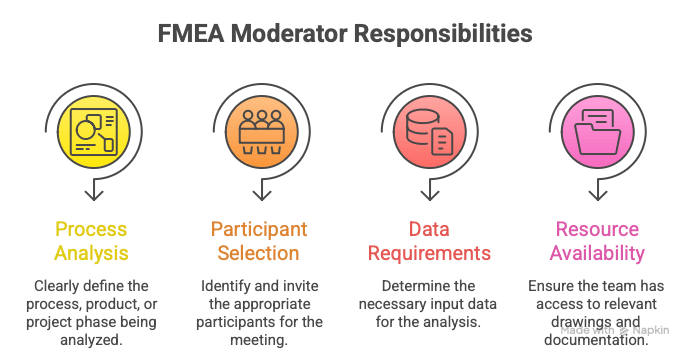
The moderator should make sure it is clear:
- which process, product, or project phase is being analyzed,
- whether the team is working on DFMEA or PFMEA,
- who should participate in the meeting,
- what input data are needed,
- whether the team has access to drawings, the process flow chart, the Control Plan, complaints, lessons learned, or the previous version of the FMEA.
Does that sound organizational? Yes. But it is not a small detail. Without this preparation, the meeting can quickly turn into a series of random decisions.
A typical problem looks like this: three people are present, but the process engineer is missing. Or the process engineer is there, but there is nobody from customer quality, even though the topic is related to a customer complaint. Or everyone is sitting at the table, but nobody knows whether the team is analyzing the current process or the process after a planned change.
And then, instead of a meaningful analysis, you get a series of assumptions.
A good moderator does not allow the team to start with empty hands.
Running the FMEA meeting
This is the moment when the role becomes most visible. During the workshop, the moderator is responsible for the flow of the analysis. They take care of the sequence, structure, and quality of the discussion. They make sure the team does not jump from one issue to another and lose the logic of the method.
At first glance, it looks quite simple: the team goes through the function, potential failure mode, effect, cause, current controls, and planned actions. In practice, this structure can disappear very quickly.
Someone starts talking about a machine setting problem. A moment later, someone else brings up operator training. Then the discussion moves to a complaint from six months ago. After ten minutes, nobody remembers which failure mode was actually being analyzed.
And this is exactly where the moderator’s role becomes visible.
The moderator stops the team and brings structure back into the discussion. They ask whether everyone is talking about the same thing. They separate the effect from the cause. They make sure that “operator performed the operation incorrectly” is not automatically accepted as the root cause. They check whether the entries are specific or only sound good.
Why does this matter?
Because in PFMEA it is very easy to create a document that looks professional but does not say much.
At this stage, the moderator is also responsible for making sure each participant contributes their knowledge where it is needed. It cannot be the case that one person talks for the whole meeting while everyone else just nods. FMEA is supposed to be teamwork. If the team does not work as a team, the analysis loses a large part of its value.
The moderator also prevents the workshop from turning into a fight over who is right. Their role is not to win the discussion. Their role is to help the team see the risk in the process.
Taking care of the quality of entries, not just the form
The moderator is responsible for making sure the entries make technical and practical sense. If the team writes statements that are too general, the moderator should stop it. If the cause is written at the level of a symptom, the moderator should catch it. If an action sounds good but nobody knows who will do it or by when, this also needs to be challenged.
This is what separates an FMEA moderator from someone who only fills in the spreadsheet.
One person takes care of the document.
The other takes care of the quality of thinking.
And that makes a big difference, especially when the organization has to return to the FMEA after a complaint, a process change, or a customer audit.
Closing actions after the workshop
At this stage, many organizations make the same mistake: they finish the meeting and treat the topic as closed.
But identifying risk does not change anything by itself. The change starts only when actions are implemented, closed, and reflected in the actual process.
That is why the FMEA moderator is also responsible for following up on what happens after the workshop.
This means checking:
- whether actions have owners,
- whether deadlines are defined,
- whether someone follows up on open points,
- whether the FMEA has been updated after changes were implemented,
- whether FMEA conclusions have been transferred further, for example to the Control Plan, work instructions, or other process documents.
This is often the point that decides whether FMEA was a useful tool or just another meeting.
If actions stay in the table and the process continues as before, the risk analysis ends exactly where it should not end: on the computer screen.
The FMEA moderator is responsible for the process, not for all technical knowledge
This distinction needs to be made very clearly.
The moderator does not have to be the top expert on every operation, machine, material, or component. Technical knowledge belongs to the team. The moderator’s job is to bring that knowledge out, organize it, and translate it into a meaningful risk analysis.
If the moderator takes on the role of an all-knowing expert, they quickly fall into a trap. They start guessing for others, simplifying the topic, or making decisions without complete data. And then FMEA stops being teamwork.
A good moderator understands the method, the logic of risk, and the dynamics of group work. They also know when to stop the meeting and say directly: without the right person or without the right data, we should not move forward.
Common mistakes when running FMEA
One of the most common mistakes is treating FMEA as a document to be closed, not as a tool for risk analysis. The team sits down with a table, enters a few general phrases, and after the meeting everyone feels that the task has been checked off.
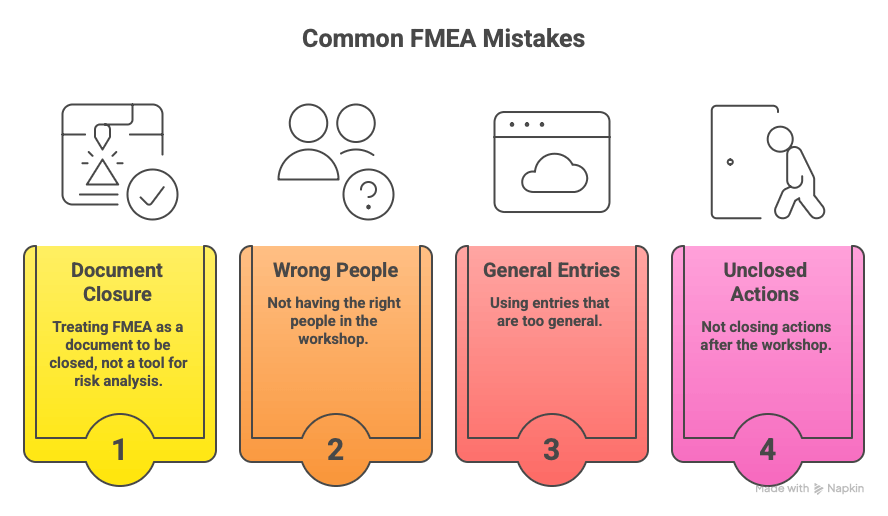
The problem is that when the first serious nonconformity appears, it turns out that the analysis did not really help.
The second common mistake is not having the right people in the workshop. If the process engineer, customer quality representative, or someone who really knows the process is missing, the team quickly starts guessing. And guessing in FMEA usually leads to weak analysis.
The third mistake is using entries that are too general. Phrases that sound correct but do not explain anything will not help later when the FMEA needs to be updated or when the team has to work on a problem. The moderator should stop such entries immediately.
The fourth mistake is not closing actions after the workshop. The table itself does not improve the process. If actions do not have an owner, a deadline, and a link to documentation or actual working practices, the FMEA stays on the computer screen.
Does the FMEA moderator have to be a process expert?
No. And that is good news, because otherwise many companies would struggle to find a person for this role.
The moderator does not have to know every process detail better than the process engineer, manufacturing engineer, or maintenance specialist. However, they should understand the logic of FMEA, know how to guide the team, and recognize when it is necessary to ask for details instead of moving forward too quickly.
This is a very important distinction. Process experts provide technical knowledge. The moderator is responsible for making sure this knowledge is used properly in the analysis. If the moderator starts replacing the team and filling in the gaps alone, the risk appears that the FMEA becomes more of a guess than an analysis.
In practice, a good person in this role does not need to know everything. They need to know how to lead the discussion so that the team reaches conclusions that make sense.
FAQ – common questions about the FMEA moderator
At the end, I have collected a few short questions that often appear when discussing the role of the FMEA moderator. If you want to quickly organize the basics of this role, this is a good place to start.
Is the FMEA moderator responsible for the entire content of the analysis?
No. The moderator is not solely responsible for all technical content of the analysis. Their role is to guide the team through FMEA in a structured way. The content comes from the people who bring knowledge about the process, risks, and existing controls.
Does the FMEA moderator make decisions alone?
No. The moderator leads the discussion and structures the analysis, but does not replace process experts. Decisions should come from teamwork, not from the opinion of one person.
Does the FMEA moderator need training?
In many cases, yes. Knowing the form is not enough if the person has to guide a team through a real risk analysis. Training helps organize the method, clarify the moderator’s role, and improve the way the workshop is run.
Summary
A well-run FMEA helps the team see risk earlier, understand the process better, and define actions that still make sense after the meeting is over. A poorly run FMEA often ends with a document that looks correct but does not help when real problems appear.
This is where the moderator matters.
The moderator keeps the logic of the analysis under control, structures the discussion, stops the team when shortcuts appear, and makes sure the conclusions do not stay only in the file. They do not replace process experts, but they help bring out what matters most in FMEA: specific thinking, clear logic, and actions that can actually be implemented.
So if, in your company, FMEA usually ends with completing a form, the problem often does not lie in the spreadsheet itself. The problem starts earlier — in the way the analysis is led.
Dariusz Kowalczyk