

Quality requirements in automotive may look clear on paper, but in practice, the biggest problems usually appear during implementation. A company updates documents, runs training sessions, closes actions in the system – and then an audit, a customer complaint, or a PPAP issue shows that the process is working differently than expected.
Why quality requirements in automotive cause so many problems
The requirements themselves are usually not the biggest challenge.
The real problem starts when a company cannot translate them into specific actions. Someone needs to define who is responsible for implementation, what exactly must change in the process, what evidence will confirm effectiveness, and who will make sure the new approach is maintained over time.
In many organizations, quality requirements are known, but they are not well connected to day-to-day operations. One part of the organization looks at customer documentation, another focuses on CSR requirements, another deals with the project, and someone else looks only at production. Everyone sees their own part, but no one connects the full picture.
The result is simple:
the requirement exists, but it does not work the way it should.
Quality requirements in automotive and documents that do not change the process
Yes — this is one of the most common mistakes.
After reviewing a requirement, someone updates a procedure, revises a form, or uploads a new instruction into the system. Formally, everything looks fine. There is a new revision, a record, and a trace that the change was made.
The problem is that the process still works the old way.
The operator follows the previous standard. The shift leader does not know the new reaction rules. The process engineer has not updated the process parameters, the control plan, or the actions required after a completed LPA audit. The logistics team continues to work as before because no one showed them that the change also affects their area.
This is where the typical gap becomes visible:
the document says one thing, but the process does something else.
In practice, quality requirements often fail exactly at this stage. The company assumes that once the file has been updated, the topic is closed. But updating a document is only the beginning.
A good control question is:
What exactly changed in the way the process operates after the requirement was implemented?
If the answer is unclear, the implementation most likely stopped at the documentation level.
CSR reviewed once and then put aside because “quality will handle it”
This is another mistake that comes back again and again.
Customer Specific Requirements are often reviewed at the beginning of cooperation with a customer, usually during a new project. Someone performs the review, prepares a list, and then the topic goes into the archive. For some time, everything seems fine.
Then the customer changes a form, reporting rules, expectations for APQP, PPAP, audits, or change management.
And suddenly, it becomes clear that the organization is still working based on outdated assumptions. That is exactly why quality requirements cannot be treated as a one-time review.
If a company does not monitor changes, the issue will come back sooner or later during a customer audit, a rejected PPAP, or an escalation.
This does not require a complicated system. In practice, three simple things are enough:
- an owner responsible for monitoring changes,
- a defined review rhythm,
- and a clear path for passing changes to the relevant departments.
Without these three elements, the organization keeps believing the topic is under control, while in reality that control was lost a long time ago.
Quality cannot implement everything on its own
In most companies, the quality department collects the requirements, prepares matrices, organizes meetings, sends reminders, and tries to connect the whole topic. The problem is that many of the actions do not end in quality. They belong to the process owners.
Examples are easy to find:
- Production must change the way the work is performed.
- Engineering must update parameters, instructions, and control methods.
- Logistics must introduce a different method of labeling or protecting material.
- Purchasing must transfer requirements into the supply chain.
- The project manager must close the topic within the launch timeline.
When everything stays on the quality side, a familiar scenario appears very quickly. Everyone assumes that someone is already managing it. And once “someone” is managing it, no one feels like the real owner on the process side.
In this kind of situation, the requirements start circulating between departments, but they do not turn into real actions.
Quality can coordinate the work. That makes sense. But implementation in the process should be led by the process owner. Without that, responsibility becomes shared. And shared responsibility has a tendency to stand still.
APQP is asleep, while PPAP is running a sprint
At the beginning of a new launch, every company organizes meetings with the implementation team. Everything seems to be under control until the PPAP submission approaches.
Then the panic starts. Some records are still missing. PFMEA and the Control Plan are not aligned.
Part of the validation has been completed, but not everything is properly documented. Some decisions were made, but no one left evidence behind. Documentation is created at the last minute just to meet the deadline.
This usually means that APQP was treated as a formal obligation, not as a real way to run the project. In such cases, quality requirements in automotive enter the project too late.
They do not guide the work from the beginning. They come back only when the customer is already asking for evidence. Sometimes that PPAP can still be submitted. But the problem returns later. At SOP. At the first customer complaints. When the customer asks additional questions. When internal process repeatability problems appear. Or when warranty returns are being analyzed.
PFMEA says one thing, the Control Plan another, and the work instruction something else
This is the kind of mistake that becomes visible very quickly during a process audit. PFMEA describes the risks and control methods. The Control Plan defines the control points. The work instruction tells the operator what to do.
A process audit should verify whether all these elements work together. Now let’s look at reality. The process changes, but only one document gets updated. The second one is left for later. The third one is not touched at all because “it was updated recently anyway.” The result?
The same process is described in several different ways. During an audit, it looks bad. On the shop floor, it looks even worse, because the employee receives inconsistent information and is then expected to run a process that the system itself describes inconsistently.
One process change should trigger a wider document review
Well-implemented quality requirements should be connected to the full package of process documents, not only to one file. If the change affects the process, the review has to go beyond a single instruction. A simple rule works well here:
after every process change, review the entire set of related documents.
That usually means PFMEA, the Control Plan, work instructions, reaction plans, audit criteria, and other linked records. If you update only one document, the inconsistency will show up sooner or later. And usually not at a convenient moment. You can find more information in the change management article.
Audits check documents, not effectiveness
Sometimes an audit is closed with no major findings, and a few days later a customer complaint appears. That is when the obvious question comes up:
What was actually checked?
If the audit focuses mainly on whether a document exists, whether a signature is in place, and whether a form has been filled out, it becomes very easy to miss what is really happening in the process.
The same applies to LPA, or Layered Process Audits.
If audit questions do not come from real risks, previous problems, process changes, or customer complaints, the audit starts to work like a ritual. It gets completed. The report is ready. But there is no visible impact on the process. And that is the real issue.
Quality requirements should not be verified only at document level. They should also be verified at operating level. People need to know what to do. Reaction rules need to be clear. Records need to make sense. An audit should show whether the system is actually working in practice. An audit that changes nothing quickly becomes just another box to tick.
Lessons learned stay locked inside one problem
This is one of the more frustrating scenarios. The problem was solved. The 8D was closed. The customer received a response. The actions were recorded. At first glance, the topic is finished.
Then, a few months later, the same type of defect comes back. In another project. Or for another customer. That usually means the organization closed the issue locally, but never transferred the learning more broadly.
It did not check where the same risk mechanism exists elsewhere. It did not expand the actions. It did not improve the standard. And as a result, the company pays for the same lesson twice. This is exactly where quality requirements should connect with 8D, audits, customer complaints, and change management.
Without that link, lessons learned becomes an empty label instead of a real tool. After every major issue, it is worth checking not only whether this one case was closed. It is also necessary to ask:
Where else could the same thing happen?
How to organize quality requirements in automotive inside the company
You do not need to start with a large project right away. In many companies, it is enough to put a few basic elements in order.
A simple cycle for organizing quality requirements
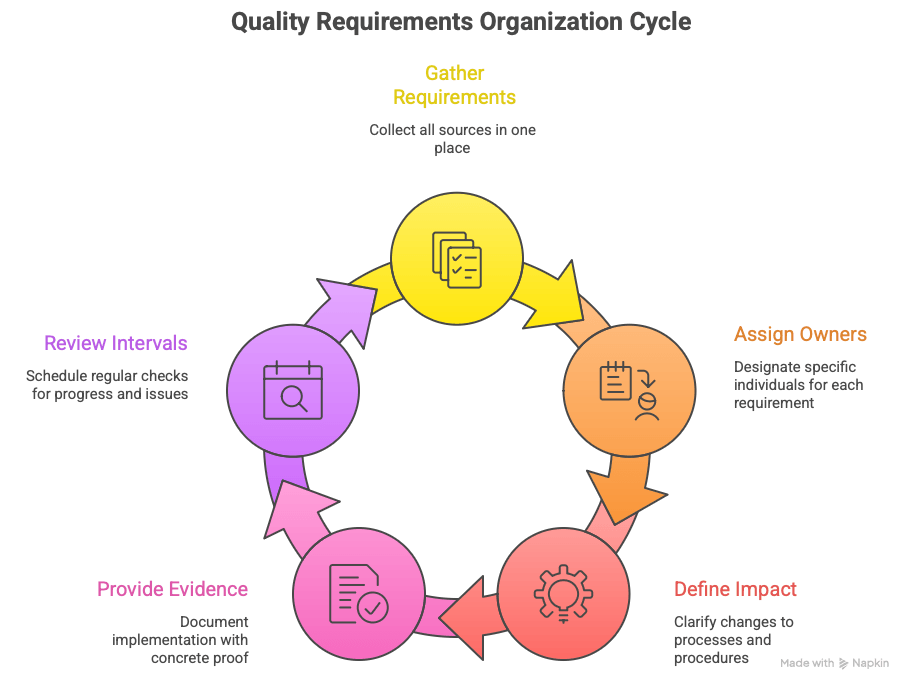
1. Gather all requirement sources in one place
IATF, CSR, customer manuals, forms, project requirements, APQP, PPAP, audit requirements, and change management requirements. If all of this is scattered, the confusion starts at the very beginning.
2. Assign an owner to each requirement
Not in general terms. Specifically.
Who leads the topic?
Who implements the action?
Who confirms closure?
Without that, the topic becomes diluted. It stays on the board for weeks and then, somehow, disappears from it without really being finished.
3. Define the impact on the process
What exactly does the requirement change? The work instruction? The type of control? The reaction to nonconformity? Identification? Validation? Communication with the customer? Requirements for the supplier?
If it is not clear what is supposed to change, the implementation will be nothing more than a smoke screen.
4. Define the evidence of implementation
“Done” is not enough. Evidence may include an updated PFMEA and Control Plan, training confirmation, a validation result, a process change record, confirmation of implementation at the supplier, or an audit result.
5. Set review intervals for planned actions
Not to create more meetings. But to check regularly:
- whether new requirements have appeared,
- whether implementation actions are really closed,
- whether any topic is coming back in complaints, audits, or internal issues.
When requirements are organized this way, they stop being a checklist. They start working as part of process management.
Checklist: do quality requirements in automotive work in practice?
At the end, run a simple test. Check these five questions:
1. Do we have one place where all applicable requirements are collected?
2. Does each requirement have a process owner?
3. Do we know exactly what changes in practice after the requirement is implemented?
4. Do we have evidence of implementation, not only an updated document?
5. Do we monitor changes and transfer the learning into similar processes?
If the answer to several of these questions is “no,” the problem is probably not the lack of a procedure.
The problem is the way the company manages implementation.
Conclusion
Most problems do not come from the content of the requirements themselves. They come from the fact that the organization mistakes documentation for implementation. And in automotive, that approach always comes back.
During an audit, a customer complaint, PPAP, a project review, a discussion with a customer who assumes that if something was implemented, then it simply works.
That is why quality requirements in automotive should not be treated as an administrative topic. They should be treated as part of process management. Because in the end, the point is not the record itself.
The point is a process that actually works in line with the requirement.
Dariusz Kowalczyk